
Why Null Hypotheses and Research Hypotheses Matter in Statistical Research
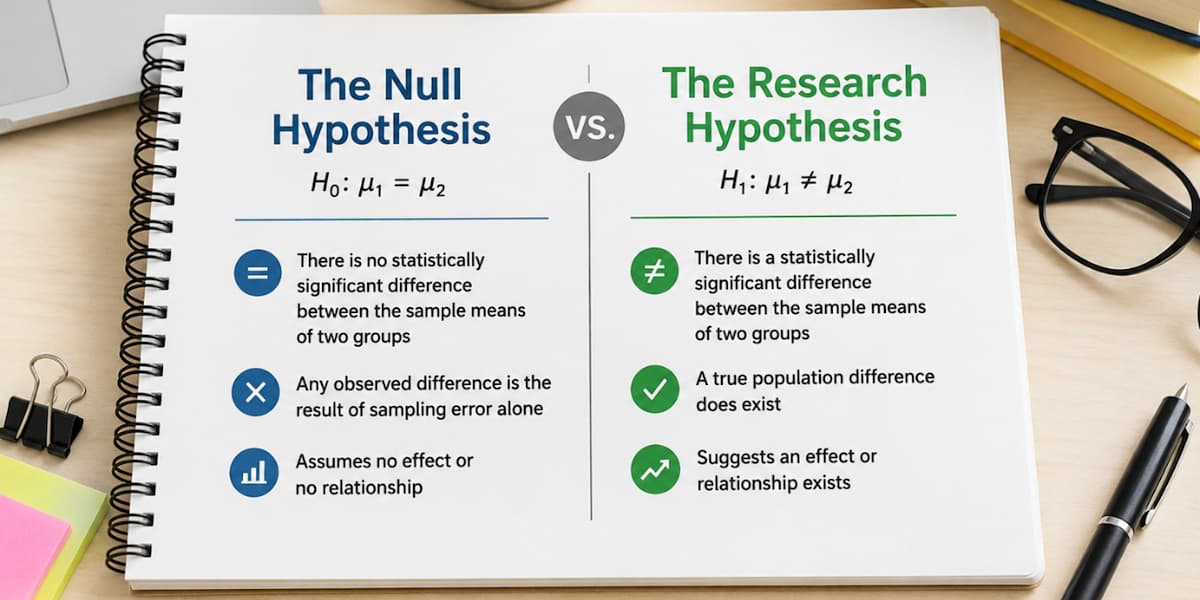
Many graduate students hear the terms null hypotheses and research hypotheses early in their dissertation journey, but they are not always sure what those terms really mean. In simple words, the research hypotheses explains what a student thinks may happen in the study. The null hypotheses says there is no relationship or difference between the groups or variables being studied. Researchers use statistics to test the null hypotheses and decide if the findings are strong enough to support the research idea.
This process helps students make conclusions based on evidence instead of personal opinions. In my experience, students understand statistics much better once they understand how hypotheses work
Quick Overview
Have you ever looked at a dissertation and wondered why hypotheses are such a big part of research?
A lot of students ask me this question.
Most research studies begin with a simple idea. A student notices a problem, asks a question, or becomes curious about something.
That curiosity turns into research.
But before collecting data, students need a clear direction. That is where hypotheses become useful.
They help students stay focused and understand what they are trying to test.
Many doctoral students feel nervous when they first start learning statistics. Some students worry they are “bad at math.” Others feel overwhelmed by research language.
I understand that feeling very well.
Through my book Simplifying Statistics for Graduate Students, I want to address this issue. I wanted students to stop feeling intimidated by statistics and research methods.
What Is a Research Hypotheses?
A research hypotheses is simply a prediction.
It explains what the researcher expects to happen in the study.
For example, a student may believe employees who receive training perform better at work. That belief becomes the research hypotheses.
The research hypotheses is usually written in a positive form because it predicts a relationship or difference.
This helps guide the study from beginning to end.
Without a clear hypotheses, students may feel lost during data collection and analysis.
Why Do Researchers Use a Null Hypotheses?
The null hypotheses is the opposite idea.
It states that no relationship or difference exists.
Researchers test the null hypotheses using statistics.
If the statistical results are strong enough, the null hypotheses is rejected.
If the results are weak, the researcher accepts the null or fails to reject it.
This process may sound technical, but it really helps researchers stay objective.
Instead of making assumptions, students use evidence from the data.
How Hypotheses Testing Works
Many students think hypotheses testing is very difficult.
Actually, the steps are fairly straightforward.
First, the researcher writes the null hypotheses.
Next, the researcher chooses a significance level such as .05 or .01.
A .05 level means there is a 95 percent confidence level.
A .01 level means there is a 99 percent confidence level and is considered more strict.
After choosing the significance level, the researcher runs the statistical test.
Then the results are examined carefully.
The goal is to decide whether the null hypotheses should be rejected or accepted.
What Does Statistical Significance Mean?
Students often hear the phrase “statistically significant,” but many are unsure what it means.
Statistical significance means the findings are unlikely to have happened by chance alone.
For example, a study may show that a training program improved employee performance.
If the statistical test is significant, the null hypotheses is rejected.
But students should remember something important.
A significant result does not always mean the finding is meaningful in real life.
I often encourage students to think beyond the numbers.
Do the results actually matter in a practical way?
That question is just as important as the statistical result itself.
Why Probability Levels Matter
Probability levels help researchers decide how careful they want to be when testing hypotheses.
Most dissertations use either:
- .05 significance level
- .01 significance level
Researchers also learn about errors in hypotheses testing.
A Type I error happens when the null hypotheses is rejected incorrectly.
A Type II error happens when a false null hypotheses is accepted.
At first, these concepts may sound confusing. But most students understand them better once they see real examples from research studies.
Understanding Directional and Nondirectional Hypotheses Types
Students should also learn about directional and nondirectional hypotheses types.
A directional hypotheses predicts the direction of the result.
For example, a student may predict that remote work increases employee satisfaction.
A nondirectional hypotheses only predicts that a relationship exists. It does not predict whether the result will increase or decrease.
This choice affects the type of statistical testing used in the study.
That is why students should think carefully before writing hypotheses.
Why Power Analysis Is Helpful
Power analysis helps students decide how many participants are needed for a study.
This step is important because a very small sample size may lead to weak results.
Many graduate students struggle with sample size decisions during dissertation research.
I often explain power analysis in simple language because students become less anxious once they understand why sample size matters.
Good planning early in the dissertation process can prevent many problems later.
Common Student Mistakes
I often see students make the same mistakes during hypotheses testing.
Some students write hypotheses that are too vague.
Others confuse the research hypotheses with the null hypotheses.
Some students choose the wrong statistical test or focus only on statistical significance while ignoring practical meaning.
I always remind students that simple and clear writing is usually better than overly complicated language.
Research should be understandable.
Closing Thoughts
Hypotheses testing is a major part of dissertation research. It helps students test ideas carefully and make decisions based on data instead of assumptions.
Many students feel stressed when they first learn statistics, but confidence grows when concepts are explained clearly and patiently.
Students do not need to feel alone during the dissertation process.
If you or your loved ones need support with dissertation statistics or research methods, consider working with me for personal guidance and dissertation help.
FAQs
1. What is a null hypotheses?
A null hypotheses states that no relationship or difference exists between variables in a study. Researchers test it with statistics to determine whether the findings are strong enough to reject it.
2. What is a research hypotheses?
A research hypotheses predicts that a relationship or difference exists in the study. It explains what the researcher expects to discover during the research process.
3. Why are hypotheses important in research?
Hypotheses help researchers stay focused and organized. They guide data collection, statistical testing, and interpretation of results throughout the research study.
4. What happens when the null hypotheses is rejected?
Rejecting the null hypotheses means the results suggest a meaningful relationship or difference exists between the variables being studied.
5. What is the difference between directional and nondirectional hypotheses?
A directional hypotheses predicts the direction of the result, while a nondirectional hypotheses only predicts that a relationship exists without predicting the direction.
6. Why do graduate students struggle with hypotheses testing?
Many students feel overwhelmed by statistics terms and research methods. Simple explanations, examples, and personal guidance usually help students understand the process more easily.
Author Bio
This blog is prepared by the team at Dissertation Statistics by Dr. Susan Carroll. The purpose is to help graduate students understand dissertation statistics and research methods in a clear and practical way.
Business Details
Dissertation Statistics by Dr. Susan Carroll
Website: Dissertation Statistics by Dr. Susan Carroll
Dr. Susan Carroll specializes in dissertation statistics and research methodology. She provides personal dissertation guidance for graduate students and is the author of Simplifying Statistics for Graduate Students.
Related Posts

Common Dissertation Statistics Problems and How To Solve Them
Quick Overview Are dissertation statistics making you feel stressed, confused, or completely stuck? Many doctoral students struggle during…

ANOVA Dissertation Help for Beginners
Need easy ANOVA Dissertation Help as a beginner? Do statistics make you nervous? Do words like ANOVA, p values, or…